
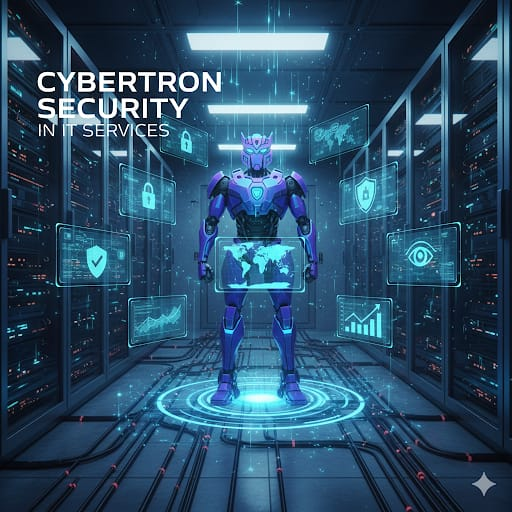
The narrative of cybersecurity has undergone a profound transformation. What began as a technical discipline concerned with firewalls and antivirus software has evolved into a strategic business function that determines organizational survival. In the contemporary IT services landscape, cybersecurity is no longer a siloed responsibility assigned to a specialized team—it is the invisible architecture underpinning every digital interaction, every data transaction, and every technological innovation.
For modern enterprises, the question is no longer whether they can afford robust cybersecurity, but whether they can afford its absence. The average cost of a data breach has reached $4.45 million globally, with certain industries experiencing losses that threaten their very existence. Yet beyond financial metrics, cybersecurity has become synonymous with business trust, regulatory legitimacy, and competitive differentiation.
This article examines the multifaceted role of cybersecurity within IT services, exploring how it has transformed from a defensive necessity into a proactive business enabler.
The Evolution: From Gatekeeping to Governance
The Perimeter Era (1990s–2010s)
Early cybersecurity operated on a castle-and-moat mentality: establish strong perimeter defenses, and trust everything inside. This model sufficed when:
- Workforces were centralized in physical offices
- Applications resided exclusively on-premises
- Data flows were predictable and contained
- Threat actors were primarily individual hackers seeking notoriety
IT services during this period treated security as a final layer—implemented after infrastructure design, often as an afterthought.
The Dissolution of Perimeters (2010s–Present)
The modern threat landscape has rendered perimeter-centric security obsolete:
- Cloud migration distributes data across global infrastructure
- Remote work extends corporate networks to home offices and coffee shops
- Supply chain complexity introduces vulnerabilities through third-party integrations
- Sophisticated adversaries include nation-states, organized crime syndicates, and corporate espionage operations
Contemporary IT services must embed security into every architectural decision, recognizing that traditional boundaries no longer exist.
The Zero Trust Imperative
Zero Trust Architecture (ZTA) represents the philosophical shift from “trust but verify” to “never trust, always verify.” In IT service delivery, this manifests as:Table
Copy
| Traditional Approach | Zero Trust Implementation |
|---|---|
| Implicit trust for internal network traffic | Continuous verification for all access requests |
| Static, perimeter-based security policies | Dynamic, identity-centric access controls |
| Annual security assessments | Real-time risk scoring and adaptive responses |
| Siloed security tools | Integrated security ecosystems with unified visibility |
Cybersecurity as Business Enabler
Trust as Competitive Currency
In an economy where digital transactions dominate, trust is the ultimate competitive advantage. Organizations that demonstrably prioritize cybersecurity gain:
- Customer loyalty: Consumers increasingly select providers based on data protection credentials
- Partner confidence: Supply chain partners require security assurance for collaboration
- Regulatory goodwill: Proactive security posture reduces regulatory scrutiny and penalty exposure
- Talent attraction: Security-conscious employers appeal to privacy-aware professionals
IT services that embed security into their value proposition transform compliance from cost center to market differentiator.
Innovation Acceleration Through Secure Foundations
Paradoxically, robust cybersecurity enables rather than restricts innovation:
Secure DevOps (DevSecOps): Integrating security into continuous integration/continuous deployment (CI/CD) pipelines allows rapid software releases without vulnerability introduction. Automated security testing catches issues in development rather than production, reducing remediation costs by orders of magnitude.
Cloud Confidence: Organizations with mature cloud security strategies migrate critical workloads faster, realizing cloud benefits (scalability, cost-efficiency, global reach) that hesitant competitors forgo.
Emerging Technology Adoption: Artificial intelligence, Internet of Things (IoT), and blockchain implementations require sophisticated security frameworks. Organizations with established cybersecurity capabilities capture first-mover advantages in these transformative technologies.
The Cybersecurity Service Portfolio
Strategic Security Consulting
Modern IT services begin with cybersecurity strategy, not technology implementation:
- Risk quantification: Translating technical vulnerabilities into financial impact scenarios
- Security maturity assessment: Benchmarking organizational capabilities against industry standards (NIST, ISO 27001, CIS Controls)
- Board-level communication: Presenting security posture in business terms that drive resource allocation
- Cyber resilience planning: Preparing for inevitable incidents through response playbooks and business continuity architectures
Identity and Access Management (IAM)
As the primary attack vector for breaches, identity security demands sophisticated service delivery:
Multi-Factor Authentication (MFA): Beyond passwords to biometric, hardware token, and behavioral verification.
Privileged Access Management (PAM): Restricting and monitoring high-risk administrative accounts with just-in-time access provisioning.
Identity Governance: Automating user lifecycle management—from onboarding through role changes to termination—ensuring access rights align with current responsibilities.
Customer Identity and Access Management (CIAM): Securing consumer-facing applications without introducing friction that drives abandonment.
Threat Intelligence and Detection
Proactive defense requires anticipating adversary behavior:
- Threat hunting: Actively searching for indicators of compromise rather than awaiting alerts
- Behavioral analytics: Employing machine learning to detect anomalous patterns invisible to rule-based systems
- Dark web monitoring: Identifying leaked credentials, planned attacks, and brand misuse before impact
- Attack surface management: Continuously discovering and assessing externally exposed assets
Incident Response and Recovery
When prevention fails, response excellence determines organizational survival:Table
Copy
| Phase | IT Service Deliverables | Business Outcome |
|---|---|---|
| Preparation | Response playbooks, communication templates, legal retainers, forensic capabilities | Minimized decision latency during crisis |
| Detection & Analysis | Automated alerting, threat validation, impact assessment | Rapid understanding of breach scope |
| Containment | Network segmentation, credential rotation, evidence preservation | Limitation of damage propagation |
| Eradication | Malware removal, vulnerability patching, backdoor elimination | Threat actor eviction |
| Recovery | System restoration, data integrity verification, enhanced monitoring | Business resumption |
| Post-Incident | Root cause analysis, control enhancement, stakeholder communication | Organizational learning and trust rebuilding |
Industry-Specific Security Imperatives
Financial Services
- Regulatory complexity: Navigating PCI-DSS, GLBA, SOX, and emerging state privacy laws
- Real-time protection: Securing high-frequency trading and instant payment systems
- Fraud prevention: Behavioral biometrics and transaction anomaly detection
- Systemic risk management: Protecting critical financial infrastructure from cascading failures
Healthcare
- Patient data protection: HIPAA compliance with clinical workflow integration
- Medical device security: Securing IoMT (Internet of Medical Things) with legacy system constraints
- Ransomware resilience: Protecting life-critical systems from encryption attacks
- Research integrity: Safeguarding clinical trial data and intellectual property
Manufacturing and Critical Infrastructure
- Operational Technology (OT) security: Bridging IT and OT networks without disrupting physical processes
- Supply chain verification: Ensuring component authenticity and software integrity
- Industrial espionage protection: Securing proprietary designs and process innovations
- Safety system protection: Preventing cyber-physical attacks with human safety implications
Professional Services
- Client confidentiality: Protecting privileged information across multi-tenant environments
- Remote workforce security: Securing distributed professionals accessing sensitive data
- Reputation management: Preventing breaches that undermine client trust and professional standing
Emerging Frontiers in Cybersecurity Services
AI-Augmented Security Operations
Artificial intelligence is transforming cybersecurity service delivery:
Automated Threat Detection: Machine learning models process billions of events to identify subtle attack patterns.
Intelligent Response Orchestration: AI systems automatically isolate compromised endpoints, block malicious IPs, and adjust firewall rules—compressing response times from hours to seconds.
Predictive Vulnerability Management: Prioritizing patch deployment based on exploit probability and business criticality rather than severity scores alone.
Adversarial AI Defense: Protecting against attackers who employ machine learning to evade detection and optimize phishing campaigns.
Quantum-Resistant Cryptography
The impending arrival of quantum computing threatens current encryption standards. Forward-thinking IT services are implementing:
- Crypto-agility: Architectures that enable rapid algorithm substitution
- Post-quantum algorithms: Deploying NIST-standardized quantum-resistant encryption
- Hybrid approaches: Combining classical and quantum-safe methods during transition periods
Extended Detection and Response (XDR)
XDR platforms unify visibility across endpoints, networks, cloud workloads, and identity systems:
- Correlated threat detection: Connecting seemingly isolated events into coordinated attack narratives
- Automated investigation: AI-driven root cause analysis and impact assessment
- Unified response: Single-console remediation across heterogeneous environments
Cybersecurity Mesh Architecture (CSMA)
As digital assets distribute across cloud, edge, and IoT environments, CSMA provides:
- Decentralized security controls: Policy enforcement at data and application layers rather than network perimeters
- Composable security: Modular services that integrate through standardized APIs
- Identity-centric protection: Security that follows users and data regardless of location
The Human Element: Culture and Capability
Security Awareness as Organizational Competency
Technology alone cannot secure organizations. IT services must address the human attack surface:
- Behavioral conditioning: Regular, realistic phishing simulations that train recognition without creating alert fatigue
- Security champions programs: Embedding security advocates within business units
- Psychological safety: Creating environments where employees report suspicious activity without fear of blame
- Executive modeling: Leadership demonstrating security-conscious behavior that cascades through organizational culture
The Cybersecurity Talent Gap
With millions of unfilled security positions globally, IT services must innovate:
- Managed security services: Outsourcing specialized functions to providers with scale and expertise
- Automation-first strategies: Reducing manual security tasks to focus human talent on complex analysis
- Diverse talent pipelines: Recruiting from non-traditional backgrounds with emphasis on problem-solving aptitude over specific credentials
- Continuous learning cultures: Keeping skills current against rapidly evolving threat landscapes
Measuring Cybersecurity Effectiveness
Beyond Compliance Checkboxes
Effective cybersecurity measurement requires outcome-oriented metrics:Table
Copy
| Traditional Metric | Modern Alternative | Rationale |
|---|---|---|
| Number of vulnerabilities patched | Mean time to patch critical vulnerabilities | Speed matters more than volume |
| Security training completion rates | Phishing simulation click rates | Behavior change over attendance |
| Firewall rule counts | Attack surface reduction percentage | Complexity reduction over control proliferation |
| Security budget as % of IT spend | Security cost per protected asset | Efficiency and scalability |
| Audit findings closed | Time to remediate high-risk findings | Risk reduction velocity |
Business Risk Quantification
Advanced IT services translate cybersecurity posture into financial terms:
- Value-at-risk (VaR) calculations: Probabilistic loss estimates for different attack scenarios
- Control effectiveness scoring: Measuring risk reduction per dollar invested
- Cyber insurance optimization: Security posture data informing coverage and premium negotiations
Conclusion: The Indispensable Foundation
Cybersecurity has transcended its origins as a technical specialty to become the essential substrate of digital business. In modern IT services, security is not a feature to be added but a quality to be inherent—not a department to consult but a perspective to embody.
Organizations that recognize this transformation gain more than protection; they acquire strategic agility. They can pursue digital initiatives with confidence, enter new markets with assurance, and build customer relationships rooted in trust. They transform cybersecurity from a cost of doing business into a catalyst for business growth.
For BitByteSys and its clients, the imperative is clear: cybersecurity must be woven into the fabric of every IT service, from initial architecture through ongoing operations. The organizations that master this integration will not merely survive the evolving threat landscape—they will thrive because of their security capabilities, turning defensive necessity into competitive advantage.
The future belongs to businesses that treat cybersecurity not as insurance against worst-case scenarios, but as the foundation upon which their digital aspirations are built.